



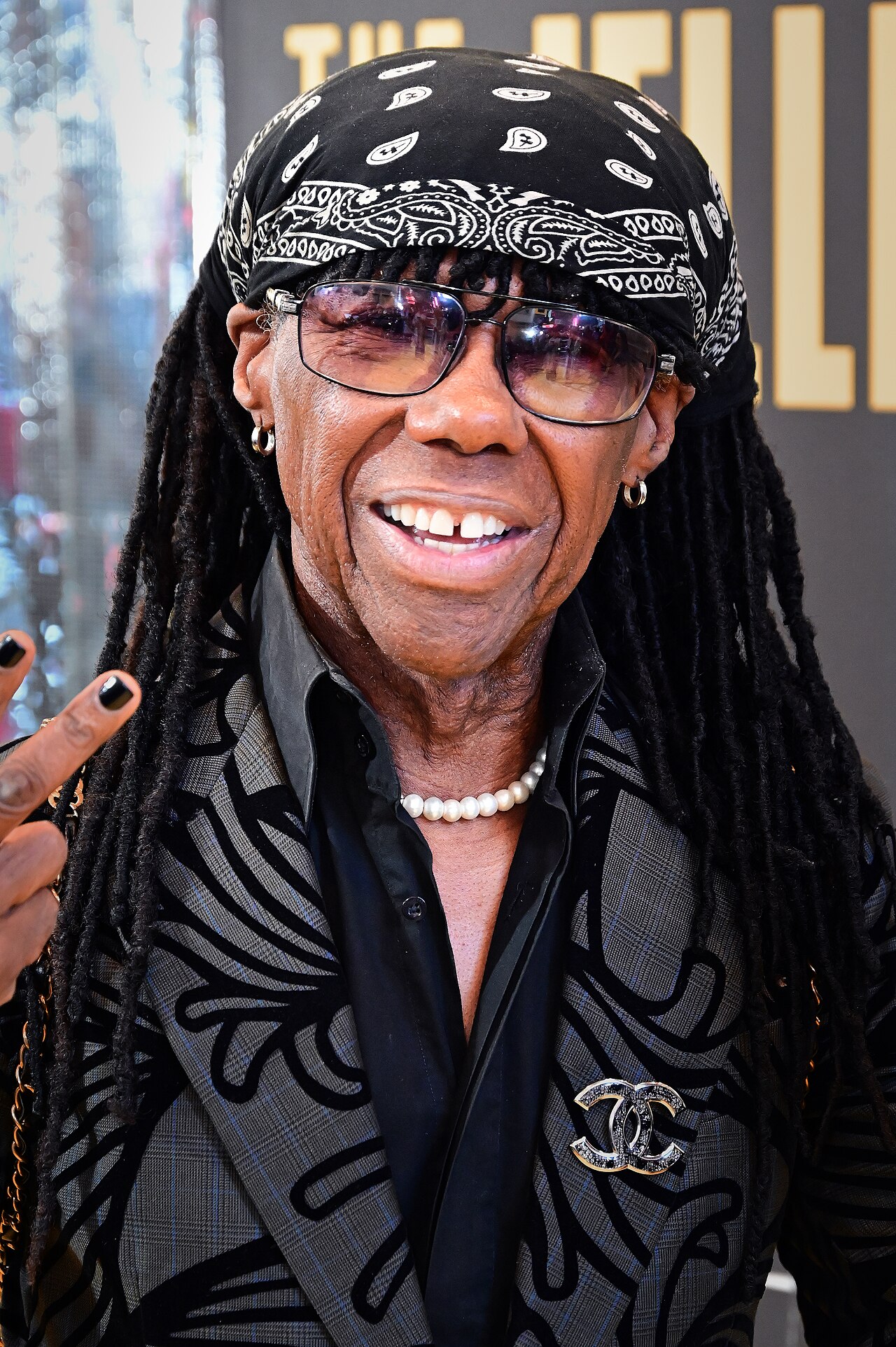

Nile Rodgers
Current Ranking
Nile Rodgers is ranked #64 of 162 guitarists on the Greatest Guitar Player leaderboard, based on our editorial score until fans weigh in. No fan votes yet, so be the first to rate Nile Rodgers on 8 attributes at greatestguitarplayer.com/vote.
Biography
Nile Rodgers, born in New York in 1952, is one of the most important and influential rhythm guitarists in the history of popular music, a player whose crisp, funky, endlessly danceable style has powered an astonishing number of the biggest hit records of the last fifty years. As the co-founder of the band Chic and as a producer and collaborator, Rodgers turned rhythm guitar into pure, irresistible groove, and his fingerprints are on a staggering swath of modern pop, disco, funk, and dance music.
Rodgers' technique is the gem, because it is unmistakable. He developed a percussive, syncopated rhythm style he calls chucking, playing tight, clipped chords high up the neck with a relentless, hypnotic groove that makes bodies move. He plays it on a single beloved Stratocaster he calls the Hitmaker, and that one guitar has appeared on records that have collectively sold hundreds of millions of copies. With Chic he created disco-era landmarks like Le Freak and Good Times, the latter built on a groove so foundational that its bassline became the basis for the Sugarhill Gang's Rapper's Delight, helping to launch hip-hop itself.
From there, Rodgers became one of the most successful producers and collaborators in music history. He produced David Bowie's blockbuster Let's Dance, Madonna's Like a Virgin, and Diana Ross's Upside Down, and decades later he co-wrote and played the irresistible guitar on Daft Punk's Get Lucky, proving his groove was as fresh in the streaming era as it was in the disco one. Across genres and generations, when artists wanted a guitar part that was guaranteed to make people dance, they called Nile Rodgers.
What makes him so remarkable is that he achieved all of this not through flashy solos but through rhythm, the often-overlooked art of playing in the pocket and making a song groove. He elevated rhythm guitar to a starring role and showed that the right funky chord pattern could be the most important element of a hit record. A Rock and Roll Hall of Fame inductee, Rodgers has also become a passionate advocate for musicians and for music education. He is living proof that rhythm guitar can change the world, the master of the groove whose one Stratocaster has soundtracked dance floors across five decades and counting.
Legendary Performance
Chic at Studio 54, 1978
When Chic took up residency at Studio 54 in 1978, Nile Rodgers was at the center of the most danceable music in New York. The performances that accompanied their Le Freak and Good Times era were spectacles of groove, precision, and showmanship, and Rodgers' guitar was the rhythmic spine around which everything else revolved.
Rodgers played his Hitmaker Stratocaster, a 1960 Fender he had heavily customized, through a small amp kept at low volume to maximize clarity. The resulting tone was bright and cutting, ideal for the percussive chucking technique that defined Chic's sound. Every chord had a rhythmic articulation distinct from anything else happening in popular music.
Those Studio 54 performances established a template for funk and dance music guitar that has been imitated thousands of times in the decades since. The fluency with which Rodgers moved between rhythm guitar and something approaching melody made his playing seem simple until another guitarist sat down and tried to replicate it.
▶ Watch on YouTubeGear
1960 Fender Stratocaster • Olympic White • Clean Tone • The Hitmaker • Minimal Processing
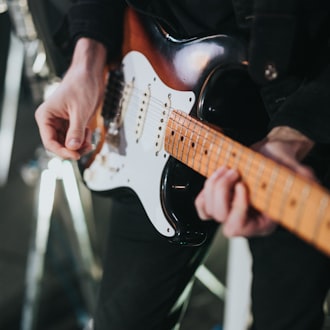
Nile Rodgers' guitar is one of the most famous individual instruments in popular music. Known as the Hitmaker, it is a 1960 Fender Stratocaster in Olympic White that Rodgers has played on virtually every significant recording of his career, from Chic's disco classics through his collaborations with David Bowie, Madonna, and Daft Punk.
The guitar has been modified over the decades: the original wiring has been altered, the neck has been refinished, and various components have been replaced as required. The modifications do not diminish its iconic status; they document a life of professional use.
Rodgers keeps his amplifier settings clean, typically using a small amplifier at low volume to preserve the Stratocaster's natural character. The cutting, percussive tone he achieves comes primarily from his right-hand technique rather than from gain or effects. He uses minimal processing, preferring the direct signal from the guitar to complex pedal chains.
Signature Technique
The Chucking Technique & Rhythmic Intelligence
Nile Rodgers developed a rhythm guitar technique so distinctive that it has its own name: chucking. The technique involves strumming chord shapes across all six strings while simultaneously muting with both the fretting hand and the picking hand, producing a percussive, clicking sound where the harmonic content is implied rather than fully sounded.
The sophistication of Rodgers' chucking lies in what he reveals and what he conceals. He selects chord voicings that contain maximum harmonic information in a compact interval range, then controls how much of that harmony is audible at any moment through precise muting. The result is a guitar part that functions as both a rhythmic percussion track and a harmonic guide.
His chord voicings are drawn from jazz harmony, frequently using extensions and alterations that add color without disrupting the dance floor functionality of the groove. He places ninths, elevenths, and thirteenths in the chord without making the music sound academic. This harmonic sophistication, delivered rhythmically, is the defining signature of his style.