



Scotty Moore
Current Ranking
Scotty Moore is ranked #120 of 162 guitarists on the Greatest Guitar Player leaderboard, based on our editorial score until fans weigh in. On the rock and roll leaderboard, Scotty Moore ranks #4 of 8. No fan votes yet, so be the first to rate Scotty Moore on 8 attributes at greatestguitarplayer.com/vote.
Biography
Winfield Scott Moore III was a 22 year old Memphis bandleader with a day job and a country outfit called the Starlite Wranglers when Sam Phillips asked him to run a few songs with a truck driver named Elvis Presley. Moore was not impressed. He called Phillips afterward and said the guy sings good, he does not really knock me out. The next evening, July 5, 1954, Moore, bassist Bill Black and Presley were killing time in Sun Studio when Presley started clowning through Arthur Crudup's "That's All Right". Black slapped along, Moore fell in behind him, and Phillips stuck his head out of the control room to ask what they were doing. Nobody knew. He told them to back up and do it again so he could get it on tape. Rock and roll guitar starts on that take.
What makes Moore the template rather than merely the first is what he chose to play. There was no drummer on those early Sun sides, so his rhythm work had to be the engine, a chugging, palm damped push that kept the record moving while he stole space for quick biting fills between the vocal lines. He called it counterpoint, like a ballroom dance with the singer. He held a flatpick with his other fingers free, which let him roll country figures and slice single notes in the same motion, and he pulled jazz and country moves from Chet Atkins, Hank Garland and Harold Bradley into a blues shuffle where nobody had put them before. The "Hound Dog" break, the "Jailhouse Rock" intro and the tumbling run out of "My Baby Left Me" are still the first fifties solos most players learn.
Here is the part most people miss. Moore was not only the guitar player, he was Presley's first manager, under a contract signed in July 1954, back when he was also booking the shows and driving the car. Colonel Tom Parker took over within the year, and as the records got bigger the sidemen's cut did not. Moore quit in September 1957 over money and access, came back weeks later on a per diem, and carried a low simmer about it for decades. Keith Richards summed up the other side of the ledger: when he heard "Heartbreak Hotel" he knew what he wanted to do with his life, and while everyone else wanted to be Elvis, he wanted to be Scotty.
He saw Presley for the last time on June 27, 1968, in a Burbank television studio, then went home to Nashville and spent most of the next thirty years behind a mixing desk, engineering and producing at Music City Recorders and elsewhere. He had already cut a solo record in 1964 with the only title it could have had, The Guitar That Changed the World!, and he came back out in 1997 for All the King's Men with a cast of players who had learned everything from him. Arthritis ended the playing around 2006. He died in Nashville on June 28, 2016, at 84, sixteen years after the Rock and Roll Hall of Fame finally let him in.
Legendary Performance
The Sit-Down Session, Elvis's '68 Comeback Special
June 27, 1968 · NBC Studio 4, Burbank, California
By the summer of 1968 Elvis Presley had spent most of a decade making movies, and the men who built the sound had scattered. NBC's plan for a Christmas special turned into something else when director Steve Binder pushed for an unrehearsed segment, Presley in a small ring of chairs on a tiny square stage, boxed in by an audience close enough to touch, playing with the people he started with. Scotty Moore and D.J. Fontana flew out. Two sit down shows were taped in NBC's Studio 4 in Burbank on June 27, 1968, and the footage that survives is the closest thing on film to what the Blue Moon Boys actually sounded like in a room.
Almost none of it was planned. Presley decided his own guitar was not loud enough and swapped instruments with Moore partway through, taking the 1963 Gibson Super 400 that became the defining image of the special and leaving Moore holding Presley's J-200 acoustic. Fontana had no kit, so he kept time on a guitar case with a pair of sticks. Charlie Hodge filled in the third guitar and the harmonies. They ran "That's All Right", "Baby What You Want Me To Do", "One Night", "Blue Christmas" and a "Lawdy Miss Clawdy" that keeps collapsing into laughing, and the looseness is exactly why it works.
It aired on December 3, 1968, and it put Presley back on the map. It was also the last time Scotty Moore ever saw him. Fourteen years of the most consequential guitar work in American popular music, and it ends with two men sitting in a circle in a television studio playing songs they cut when they were kids.
▶ Watch on YouTubeGear
Gibson ES-295, "The Guitar That Changed the World" (1953)
Known for: Elvis's first four Sun singles, starting with "That's All Right"
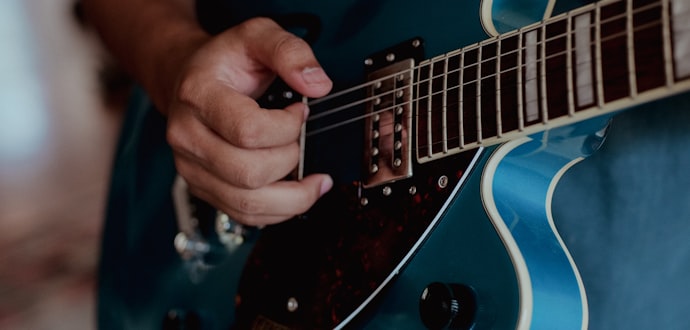
Moore spotted the gold ES-295 in the window at O.K. Houck Piano Company in Memphis in 1953, traded in his Fender Esquire and walked out with it the same day. It was a strange choice for what he was about to do with it, a hollow archtop finished in gold lacquer with two white covered P-90s and a trapeze tailpiece, built to look expensive rather than to fight feedback. He modified it anyway, swapping in a Melita Synchro-Sonic bridge and a Kluson tailpiece so it would hold tune under the beating he gave it.
That guitar is on Presley's first four Sun singles, which is to say it is on the records that separate rock and roll from everything before it. Moore traded it for a blonde Gibson L-5 CESN on July 7, 1955, days before cutting "Mystery Train", and moved up to a Super 400 in 1957 for the Jailhouse Rock and King Creole soundtracks. He stayed on big Gibson archtops for the rest of his career, which is part of why the tone never sounds like anyone else's. He was making rockabilly records on a jazz box.
Ray Butts EchoSonic
Known for: putting studio slapback on a stage, from "Mystery Train" to the '68 special
Sam Phillips got his slapback at Sun by running tape between two machines, which worked beautifully until the band had to play the song in front of people. Ray Butts, who ran a music store in Cairo, Illinois, solved it by building a tape loop into a combo amp, roughly 25 watts through a single twelve. Moore bought one in May 1955 for 495 dollars, more than double the price of a Fender Twin at the time, and it closed the gap overnight. The record and the show finally sounded like each other.
Butts made fewer than seventy of them. Chet Atkins had one, Carl Perkins had one, Roy Orbison and Luther Perkins had them, and that short list is close to a map of where rockabilly and the Nashville sound came from. Moore's EchoSonic went with him from "Mystery Train" all the way to the Burbank soundstage in 1968, a long service record for a piece of gear with a moving tape mechanism inside a rattling combo cabinet.
No Pedals, Just the EchoSonic's Tape Loop
There is no pedalboard in this story. Everything people chase about the Scotty Moore sound comes from three things, the archtop's neck pickup rolled back a touch, the EchoSonic's tape echo set short with a single repeat, and the room. Phillips layered his own slapback onto the Sun masters, so a few of those records are echo stacked on echo, which is why three men in a small room sound so much bigger than they should.
Players going after it today usually reach for a tape delay or a slapback around 100 to 150 milliseconds, one repeat, no feedback. That gets the surface. The part that does not come out of a box is Moore's right hand, which is doing most of the work the echo gets credit for.
Signature Technique
Flatpick-and-Fingers Counterpoint & Rockabilly Slapback
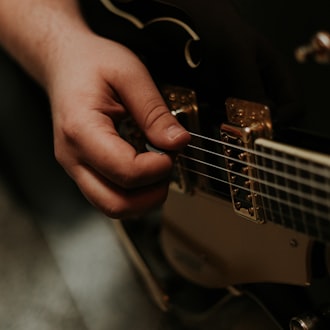
Moore held a flatpick between thumb and index and left his remaining fingers free, so he could snap a bass figure and pluck the top strings in one motion. That hybrid grip is why his parts sound like two guitarists. It let him keep a rolling, palm damped rhythm running under the vocal while flicking in the single note answers that fill the gaps, and on the early Sun sides, where there was no drummer at all, that rhythm was the only thing holding the record together.
He described the job as counterpoint, a ballroom dance with the singer. In practice that meant never getting in the way of the vocal and never leaving a hole either. Listen to what he does under the verses of "Heartbreak Hotel", low and spare and almost sullen, and then how the solo climbs up out of it. He was not trying to be the loudest thing on the record. He was trying to be the thing that makes the singer sound inevitable.
His vocabulary came from three places nobody had combined. Chet Atkins gave him the fingerstyle rolls and the chord melody thinking. Jazz players like Hank Garland and Harold Bradley gave him the passing chords and the sixths. The blues coming out of Memphis gave him the bends and the attitude. Drop all that into a shuffle and you get the "Jailhouse Rock" intro, the "Hound Dog" break and the tumbling triplet run out of "My Baby Left Me", which remain assignment number one for anyone learning fifties lead guitar.
The last piece is the echo, and it matters more than it sounds. A short slapback smears every note into the one behind it, so a sloppy player turns to mud while a precise one sounds enormous. Moore was precise. He picked hard and clean, muted aggressively with the heel of his hand, and let the repeat do the widening. Tight right hand plus one slap of tape delay is the entire rockabilly guitar sound, and every player who has gone after it since is working from what Moore figured out in 1955.