



T-Bone Walker
Current Ranking
T-Bone Walker is ranked #47 of 162 guitarists on the Greatest Guitar Player leaderboard, based on our editorial score until fans weigh in. On the blues leaderboard, T-Bone Walker ranks #10 of 32. No fan votes yet, so be the first to rate T-Bone Walker on 8 attributes at greatestguitarplayer.com/vote.
Biography
Aaron Thibeaux Walker was born on May 28, 1910, in Linden, Texas, and raised in the Oak Cliff neighborhood of Dallas, where the nickname T-Bone grew out of his mother's pronunciation of Thibeaux. Music surrounded him from the start. His mother and stepfather both played, and the family's house guests included Blind Lemon Jefferson, the biggest blues star in Texas. As a boy, T-Bone worked as the blind singer's lead boy, guiding him along Central Avenue in Dallas and passing the tin cup while Jefferson played. He cut his first record in 1929 for Columbia under the name Oak Cliff T-Bone, a scratchy acoustic 78 that gave no hint of the revolution he was about to lead.
That revolution was the electric guitar. After moving to Los Angeles in the mid 1930s, Walker sang with Les Hite's orchestra and began experimenting with amplified guitar at a time when almost nobody knew what to do with one. In 1942 he recorded "Mean Old World" and "I Got a Break Baby" with pianist Freddie Slack, sides widely regarded as the first true electric blues guitar records ever made. Five years later came the song that defined him and the genre, "Call It Stormy Monday (But Tuesday Is Just as Bad)," a slow blues so elegant and so widely covered that it became the common language of every blues bandstand on earth.
Walker was also the music's first great electric showman. Decades before Chuck Berry duck walked or Jimi Hendrix played behind his back, T-Bone was dropping into full splits mid solo, holding his big Gibson archtop flat against his chest like a tray, and playing it behind his head without missing a note. The influence he cast is almost impossible to overstate. B.B. King said that hearing "Stormy Monday" was what made him go out and buy an electric guitar, calling it the prettiest sound he had ever heard. Chuck Berry named Walker as a primary influence, and the horn-like phrasing he invented became the foundation for practically every electric blues and rock lead player who followed.
Walker spent the 1950s and 1960s as a touring headliner, joining the Jazz at the Philharmonic tours and introducing European audiences to electric blues through the American Folk Blues Festival. In 1971 he won a Grammy for the album Good Feelin', a late career recognition of a man whose innovations had long since been absorbed into the bloodstream of popular music. Slowed by a stroke in 1974, he died of pneumonia in Los Angeles on March 16, 1975, at age 64. The Blues Foundation inducted him into its Hall of Fame in its inaugural 1980 class, and the Rock and Roll Hall of Fame followed in 1987, honoring the man who, more than any other single figure, plugged the blues in.
Legendary Performance
"Call It Stormy Monday" Session
September 13, 1947 · Black & White Records, Hollywood, California
By September 1947, T-Bone Walker was the biggest draw in West Coast blues, and Black & White Records brought him into a Hollywood studio with a small jump combo to capture what he did nightly on the Central Avenue circuit. Out of that session came "Call It Stormy Monday (But Tuesday Is Just as Bad)," a slow blues built on chiming ninth chords and a vocal delivered with the weary elegance of a man singing about the working week from deep inside it. The record moved at a crawl and glowed like neon, and its guitar introduction became one of the most quoted passages in American music.
What made the session historic was the way Walker's guitar carried the record. Every fill answered the vocal like a second singer, every chord voicing added color instead of bulk, and the solo unfolded in smooth, horn-like single notes at a moment when most blues guitarists were still hammering acoustic rhythm. Musicians heard it and changed course. B.B. King credited the record with putting an electric guitar in his hands, the Allman Brothers Band later built one of the great live showpieces of the rock era on its changes at the Fillmore East, and the song became the most covered slow blues ever written. One three minute record from one afternoon session effectively drew the blueprint for electric blues, and every bar band that has ever called "Stormy Monday" on a slow night is quoting this performance.
▶ Watch on YouTubeGear
Gibson ES-5 "The Blonde Archtop" (1950)
Known for: Held flat against his chest for the splits and behind-the-head showpieces
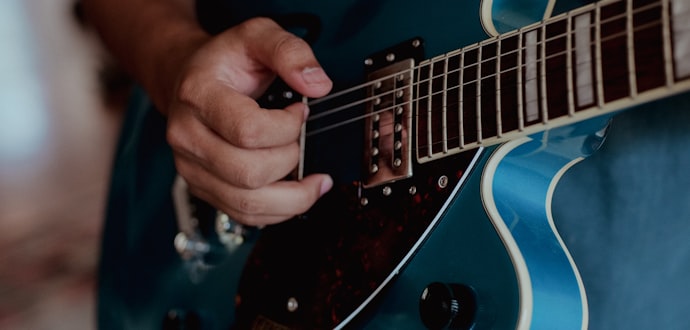
The image of T-Bone Walker is inseparable from the big blonde Gibson ES-5 he played from around 1950 onward, an oversized hollow-body archtop with three P-90 pickups that he wielded like a piece of stagecraft. He held it flat against his chest, almost parallel to the floor, a grip that looked impossible and made his behind-the-head and full-splits routines flow naturally out of the way he already carried the instrument. Through that unusual angle he pulled a warm, rounded, singing tone with just enough amplifier push to bloom without distorting.
Before the ES-5, Walker did his pioneering early 1940s work on a Gibson ES-250, the short-lived successor to the ES-150 that Charlie Christian made famous. The lineage matters: the two men knew each other from Oklahoma and Texas days, reportedly traded ideas as teenagers, and between them took Gibson's first electric archtops and split the future of the instrument, Christian pointing it toward jazz and Walker toward the blues. Walker stayed loyal to fat hollow-body Gibsons his whole career, and their airy, woody response is a defining ingredient of the electric blues tone every player since has chased.
Gibson EH-185 Combo
Known for: The soft-edged warmth of the first electric blues records
Walker's early amplification was whatever Gibson made to pair with its electric archtops, the tweed-era EH series combos like the EH-185 that gave his 1940s sides their soft-edged, slightly hairy warmth. These were low-wattage amps designed for dance bands, and Walker ran them just past clean, which is why those first electric blues records sound rounded and vocal rather than sharp. As bigger stages arrived in the 1950s and 1960s he moved to larger combo amps of the day, but he never chased volume for its own sake. The amp's job was to make the guitar sing at horn level in a jump band, and everything about his touch was calibrated to that sweet spot where the note blooms but never breaks.
None, straight into the amp
There were no effects. Walker plugged his Gibson straight into the amplifier for his entire career, and the variety in his sound came from his hands: the angle of the pick, the weight of a finger vibrato, the snap of a double stop, the dynamics of a band arrangement dropping to a whisper behind him. The cleanliness was the point. Every nuance of his phrasing arrived at the listener unprocessed, which is exactly why players from B.B. King onward could hear precisely what he was doing and spend their lives working out how.
Signature Technique
Horn-Style Single-Note Lines & The T-Bone Shuffle
T-Bone Walker invented the vocabulary of electric blues lead guitar, and the heart of it was treating the guitar like a horn. Where country blues players thumped and strummed, Walker played smooth single-note lines that breathed like a saxophone, phrased across the beat with a jazz musician's sense of swing. His notes were clean, connected, and conversational, set up in short call-and-response exchanges with his own vocal. That approach, the guitar as a second voice answering the singer, became the template for B.B. King and through him for essentially all modern blues and rock soloing.
Underneath the lines sat his signature harmony: ninth chords, slid into from a half step below and stabbed on the upbeats. The two-bar figure now known as the T-Bone shuffle is built entirely from those voicings, and it remains the first thing any student of Texas blues rhythm learns. Walker used the ninth chord the way a big band used its horn section, as punctuation, and the urbane, uptown color it added is a big part of why his blues sounded sophisticated rather than rough.
His right hand worked with a light, precise attack, often plucking near the neck for roundness, while his left favored sweeping position shifts over string bending. He bent notes sparingly and shallowly compared to the players he inspired, getting his expression instead from slides, grace notes, and a fast, shimmering finger vibrato. Listen to the intro of "Call It Stormy Monday" and nearly every device of the modern blues intro is already present: the chromatic approach, the held ninth, the lazy triplet fall.
Then there was the showmanship, which was itself a technique. Playing the guitar behind his head, doing the splits mid phrase, holding the instrument flat against his body, none of it interrupted the music, and that combination of physical spectacle with unbroken musicality set the standard for every guitar showman since. Chuck Berry took the moves, Buddy Guy took the audacity, Hendrix took the idea that the performance and the playing could be one continuous act. All of them were drawing from the man from Oak Cliff.