








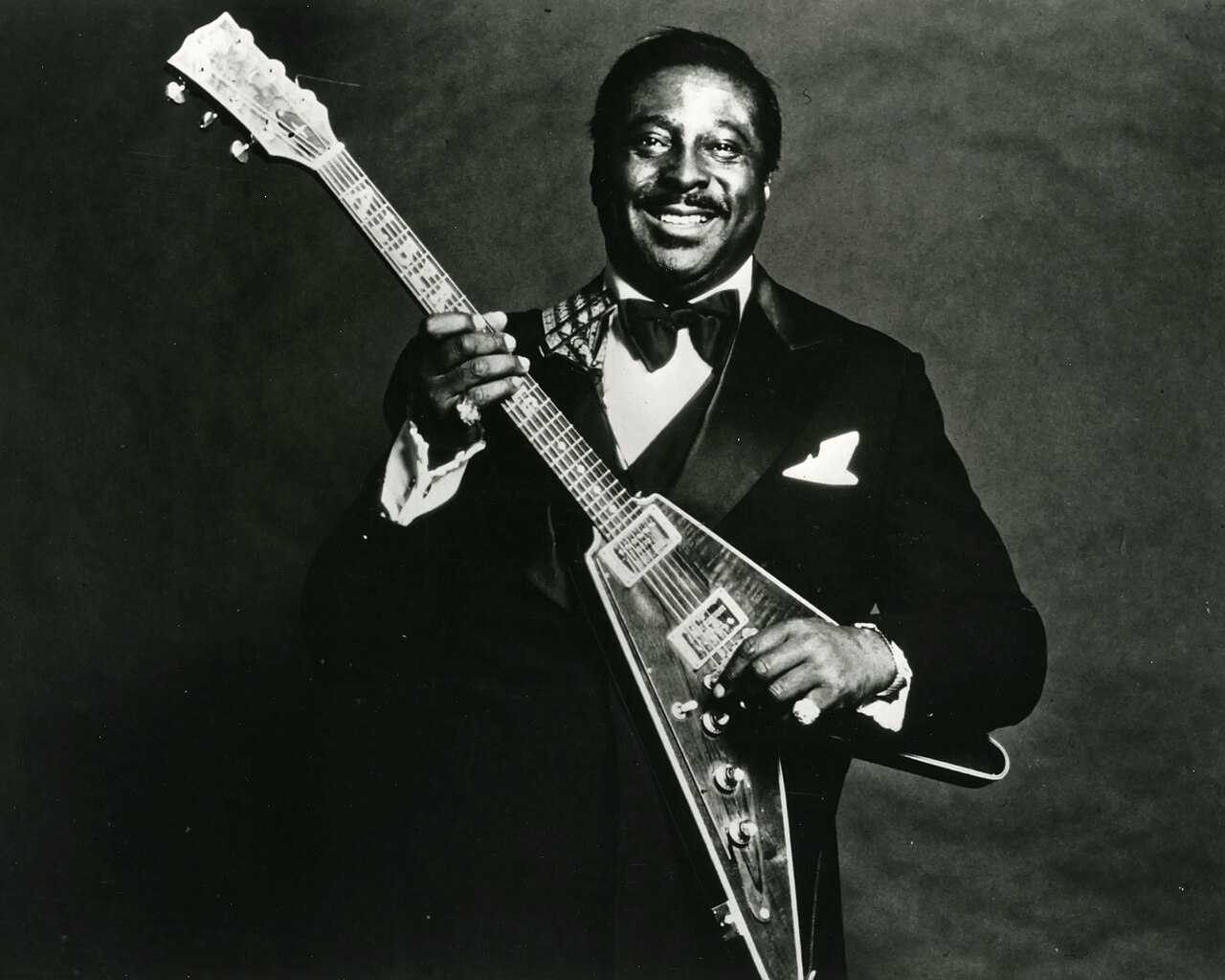

Albert King
Current Ranking
Albert King is ranked #70 of 162 guitarists on the Greatest Guitar Player leaderboard, based on our editorial score until fans weigh in. On the blues leaderboard, Albert King ranks #13 of 32. No fan votes yet, so be the first to rate Albert King on 8 attributes at greatestguitarplayer.com/vote.
Biography
Born Albert Nelson in Indianola, Mississippi in 1923, Albert King grew up chopping cotton and singing in church before he became one of the towering figures of electric blues, ranked alongside B.B. King and Freddie King as one of the genre's three royal Kings. A giant of a man, well over six feet and pushing 250 pounds, he played with a physical authority that matched his frame, and his enormous, vocal string bends became one of the most copied sounds in all of guitar.
King was left-handed, and the way he dealt with that is the heart of his mystery. He took a right-handed Gibson Flying V, his beloved guitar he called Lucy, flipped it upside down, and played it without reversing the string order, so the strings ran the opposite way from any normal setup. On top of that he used his own personal tuning, almost certainly some kind of open minor or dropped arrangement, that he never fully explained to anyone. The combination let him pull strings downward and stretch notes impossibly far, and to this day players argue about exactly how his guitar was tuned because no one has perfectly reverse-engineered that crying, rubber-band tone.
His defining era came at Stax Records in Memphis in the 1960s, backed by Booker T. and the MGs, the same crack rhythm section behind Otis Redding and Sam and Dave. That partnership produced Born Under a Bad Sign in 1967, a record so foundational that its title track has been covered by everyone from Cream to Hendrix, plus standards like Crosscut Saw and the slow-burning I'll Play the Blues for You. Where many bluesmen played a flurry of notes, King played fewer, each one squeezed and shaken until it spoke.
Here is the gem for guitar obsessives: Stevie Ray Vaughan idolized Albert King so completely that their 1983 television meeting, later released as the album In Session, plays like a master and his most gifted student finally trading licks, with King gently needling the younger man the whole time. King's fingerprints are all over Vaughan, Hendrix, Clapton, Gary Moore, and Joe Bonamassa. He kept touring almost until his death in 1992, and the sound of that upside-down Flying V bending notes toward the sky remains one of the blues' great unsolved magic tricks.
Legendary Performance
Blues Power at Fillmore Auditorium
When Albert King took the stage at the Fillmore in October 1968, he delivered one of the most electrifying blues performances ever committed to tape. Armed with his upside-down Flying V 'Lucy,' King played with a ferocious authority that left Jimi Hendrix, sitting in the audience, visibly awestruck. The recordings from that night, later released as Live Wire / Blues Power , capture a master at his most commanding, bending strings with a chokehold grip that created notes no textbook could teach.
King's left-handed, upside-down fretting style produced a distinctively raw, crying tone that became the template for an entire generation of blues-rock guitarists. Eric Clapton, Stevie Ray Vaughan, and Gary Moore all openly cited that Fillmore run as transformative. There was no showmanship for its own sake, just a big man, a big guitar, and an unshakeable command of the blues idiom that reshaped what electric guitar could mean.
▶ Watch on YouTubeGear
Gibson Flying V 'Lucy'
Albert King's relationship with his upside-down, left-handed Flying V, nicknamed 'Lucy', is one of the great guitar-player pairings in blues history. King was a right-handed player who flipped the instrument and played it without restringing, meaning the bass strings were at the bottom and the trebles at the top from his perspective. This unconventional setup, combined with his massive left-hand strength, produced string bends of extraordinary width and a tone that was simultaneously brutal and lyrical. Lucy's mahogany body and stop-bar tailpiece gave his playing a thick, sustaining midrange that cut through any mix.
Gibson GA-100 / Acoustic 360
King was not doctrinaire about amplification, he used a variety of setups throughout his career, including the massive Acoustic 360 bass amplifier that added weight to his already imposing low end. Whatever he ran through, King's tone retained its characteristic thickness and authority. His amp settings tended toward high mids and a clean-to-slightly-breaking tone that let the guitar's natural sustain do the heavy lifting rather than artificial gain.
Minimal Signal Chain
Albert King was famously minimalist in his approach to effects. He relied almost entirely on his hands, his extraordinarily powerful grip, his precise pick attack, and his audacious string bends, rather than any external processing. Occasional use of a simple spring reverb was the extent of his signal chain on most recordings. This stripped-back approach underscored his core philosophy: the tone is in the fingers, and no pedal board can substitute for sixty years of devotion to the blues.
Signature Technique
Reversed Upside-Down String Bending
Albert King played a right-handed Flying V strung left-handed, held in a right-handed playing position, which meant his fretting hand operated the strings in the opposite direction from every other guitarist. When he bent a string, he pushed it downward rather than pulling it up, and his picking hand attacked from below the strings rather than above. The physics of the bend were entirely reversed. The result was a huge, distinctive downward bend with a heavier physical quality that no player using a conventionally strung instrument could exactly reproduce. His bends were enormous, sometimes a minor third or more, and landed on their target notes with an unhurried precision that made them sound inevitable rather than effortful.
Stevie Ray Vaughan, who idolised King and studied his records obsessively, openly credited these bends as the foundation of his own approach. The trick, attempted by many, duplicated by none, is that when a right-handed player tries to copy an Albert King bend, the string goes up while the sound in their ear says it should be going down. The approach required its own muscle memory, its own physics. "Born Under a Bad Sign" is the essential document: every phrase in the solo bends in the Albert King direction, and every bend lands somewhere no conventional player quite reaches.