




Doc Watson
Current Ranking
Doc Watson is ranked #122 of 162 guitarists on the Greatest Guitar Player leaderboard, based on our editorial score until fans weigh in. On the country and roots leaderboard, Doc Watson ranks #10 of 11. No fan votes yet, so be the first to rate Doc Watson on 8 attributes at greatestguitarplayer.com/vote.
Biography
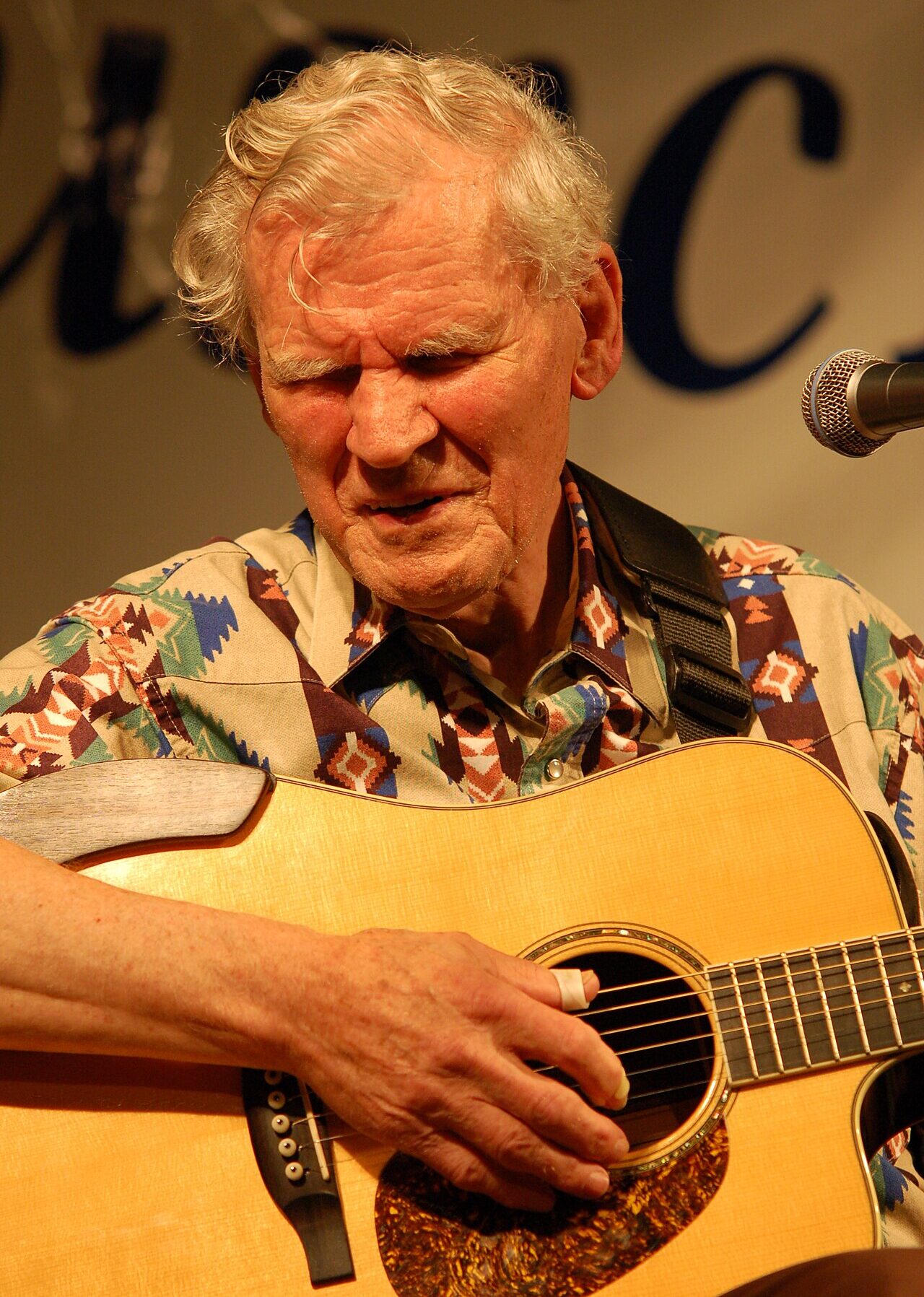
Doc Watson, born in the mountains of North Carolina in 1923, was the father of flatpicking and one of the most beloved and influential acoustic guitarists America ever produced. Blind from infancy due to an eye infection, he grew up surrounded by traditional Appalachian music, learned harmonica and banjo as a boy, and took up guitar as a teenager, eventually developing a style that would quietly revolutionize how the instrument is played in folk and bluegrass.
Here is the gem at the center of his legacy. Before Doc Watson, the lightning-fast fiddle tunes of Appalachian and bluegrass music were the territory of the fiddle and banjo, while the guitar was mostly a background rhythm instrument. Watson changed that single-handedly by working out how to play those intricate, blisteringly quick fiddle melodies note-for-note on a flatpicked acoustic guitar, turning it into a lead instrument capable of carrying the tune. That approach, now simply called flatpicking, became a foundational technique for generations of acoustic players, and essentially every bluegrass and folk flatpicker who followed is working in the tradition he established.
What made it all the more remarkable was his warmth and humility. Watson played with breathtaking speed and accuracy, but never coldly, always with a deep feel for the song and a rich, friendly baritone voice to match. He was discovered during the folk revival of the early 1960s and became a star of festivals and concert halls, introducing old mountain songs and his dazzling guitar work to huge new audiences. He won a stack of Grammys and a National Medal of Arts, and he did it all by ear, navigating stages and fretboards through sound and feel alone.
For years he performed alongside his son Merle, named in tribute to the guitar great Merle Travis, in a cherished father-and-son partnership cut short by Merle's death in a 1985 accident, a loss Doc honored by founding the long-running MerleFest music festival in his memory. Watson kept performing almost until his death in 2012, a living link to the deep roots of American music. He took a humble rhythm instrument, taught it to fly through tunes no one thought it could play, and did it with such grace that he is remembered not just as a virtuoso but as one of the warmest, most generous figures the guitar has ever known.
Legendary Performance
Newport Folk Festival, 1963
Doc Watson's appearance at the Newport Folk Festival in 1963 introduced him to a national audience and set off a reversal of assumptions about what acoustic guitar could do in a folk music context. Watson played with a speed, precision, and technical command that audiences had not encountered in folk performance, and he did it on a Martin flat-top with an ease that suggested the difficulty was beside the point.
Watson brought flatpicking technique developed in the dance halls of North Carolina to a stage that had seen mostly strumming and fingerpicking. His renditions of traditional fiddle tunes like Black Mountain Rag , executed at full fiddle tempo on a guitar, were revelations. The Newport audience, largely composed of musicians and music critics, understood immediately that they were seeing something genuinely new.
Watson performed blind from birth, which meant his musical education came entirely through listening and practice rather than notation or visual demonstration. The technique he developed was self-invented within a tradition, and its influence on every subsequent generation of flatpickers, from Clarence White to Tony Rice, has been total.
▶ Watch on YouTubeGear
Martin D-28 • Gallagher Doc Watson Model • Flat Pick • Light Strings • Acoustic Flatpicking
Doc Watson played acoustic guitar exclusively for most of his performing life, and his instrument of choice was a Martin D-28, the dreadnought flat-top that has been standard equipment for serious bluegrass and flatpicking players since the 1940s. The D-28's powerful, resonant projection suited Watson's technique perfectly: his flatpicking required a guitar that could project clearly at volume across a band or festival context.
Watson also had a long association with Gallagher Guitar Company, a small Tennessee manufacturer whose instruments he endorsed for decades. The Gallagher Doc Watson model, built to his specifications, featured a slightly modified bracing pattern and construction details optimized for the flatpicking style.
For picks, Watson preferred a medium-gauge flat pick, holding it firmly enough to execute rapid alternate picking without losing control but loosely enough to allow the slight give that prevents injury over long playing sessions. His strings were standard light acoustic gauge, a compromise between projection and playability that suited his style.
Signature Technique
Flatpicking at Fiddle Speed
Doc Watson's central technical achievement was the demonstration that a flat pick on an acoustic guitar could execute fiddle tunes at fiddle tempo without sacrificing either the melody's clarity or the instrument's characteristic acoustic warmth. This was considered nearly impossible before Watson proved otherwise, and it established a benchmark that flatpickers have been pursuing ever since.
His picking technique uses strict alternate picking for most passages: down stroke followed by upstroke, the pick traveling the minimum necessary distance between strokes to maximize speed. His right hand remained relaxed even at maximum tempo, a quality that allowed him to sustain the technique over long sets without the tension accumulation that destroys precision.
Watson's left-hand technique was equally developed, with hammer-ons and pull-offs deployed to minimize pick strokes during fast passages, a technique sometimes called chicken pickin' in the country context but here applied to fiddle tunes with classical discipline. He also had an extensive chord vocabulary that he deployed in the melodic chord passages between instrumental runs.