








Robert Johnson
Current Ranking
Robert Johnson is ranked #45 of 162 guitarists on the Greatest Guitar Player leaderboard, based on our editorial score until fans weigh in. On the blues leaderboard, Robert Johnson ranks #8 of 32. No fan votes yet, so be the first to rate Robert Johnson on 8 attributes at greatestguitarplayer.com/vote.
Biography
Robert Johnson, born in Mississippi around 1911, is the most mythologized figure in the history of the blues, a Delta guitarist and singer whose small body of recorded work became one of the most influential bodies of music in the twentieth century. Despite recording only about two dozen songs and dying young and obscure, Johnson cast a shadow so long that the entire course of blues and rock guitar can be traced back through him, and the legend surrounding his life has made him an almost supernatural figure.
Here is the gem, the most famous myth in all of music. According to legend, Robert Johnson, frustrated by his early mediocrity on the guitar, took his instrument to a crossroads at midnight, where he supposedly made a deal with the devil, trading his soul for unearthly musical talent. He returned, the story goes, transformed into a guitarist of stunning ability, and songs like Cross Road Blues and Me and the Devil Blues fueled the tale for generations. The myth is almost certainly folklore embroidered after his death, but it captures something real about the eerie, otherworldly quality of his playing, which seemed to come from nowhere and sounded, on record, as if two guitarists were playing at once, thanks to his sophisticated combination of driving bass, rhythm, and stinging slide.
The reality behind the myth is just as remarkable. Johnson's recordings, made in makeshift studios in the late 1930s, reveal a player of extraordinary skill and emotional intensity, with a haunting voice and intricate technique far ahead of his time. Songs like Sweet Home Chicago, Love in Vain, and Hellhound on My Trail became foundational texts of the blues, covered and studied for generations.
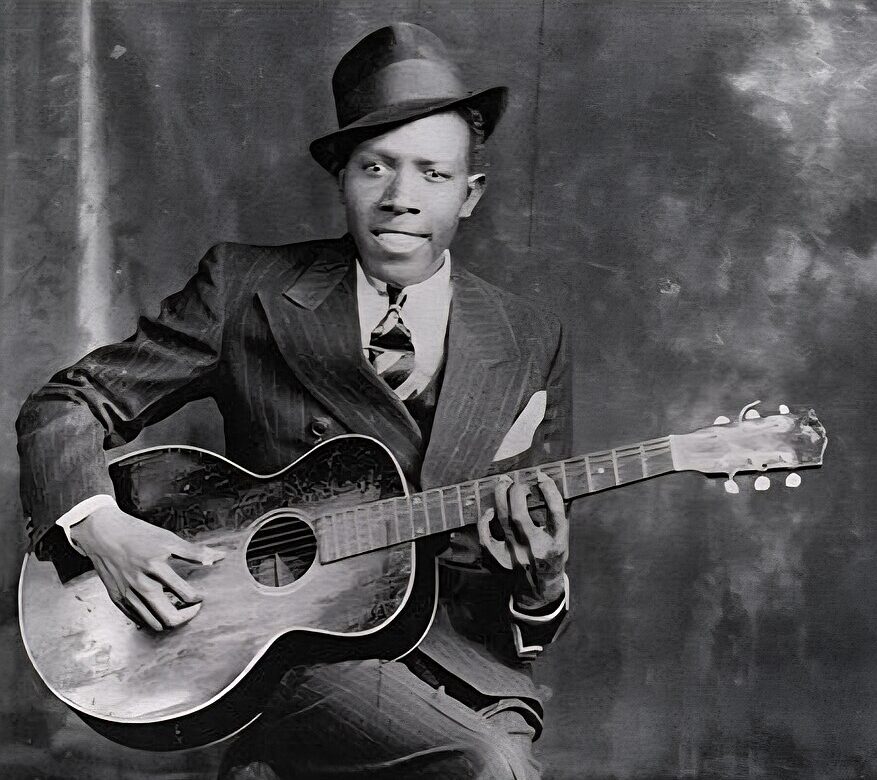
A second gem deepens the mystery. For decades almost nothing was known about Johnson's life, and only a couple of verified photographs of him are known to exist, so the world built its image of him almost entirely from his music and his legend. He died in 1938 at just twenty-seven, reportedly poisoned by a jealous husband, becoming the original and defining member of the tragic club of musicians lost at that haunting age. The scarcity of facts only amplified his mystique, turning him into a kind of blank screen onto which the blues projected its deepest mysteries.
Johnson's influence on the rock era is staggering. Eric Clapton called him the most important blues musician who ever lived, the Rolling Stones and Led Zeppelin covered and adapted his songs, and when his recordings were reissued decades after his death, they introduced his genius to a vast new audience and cemented his status as the King of the Delta Blues. A Rock and Roll Hall of Fame inductee honored as an early influence, Robert Johnson remains the haunting, mysterious wellspring from which so much of modern guitar music flows, the man whose handful of songs and unforgettable legend changed everything.
Legendary Performance
Delta Juke Joints, 1936-1937
Robert Johnson never played Carnegie Hall or Madison Square Garden. His stages were the roadhouses, juke joints, and street corners of the Mississippi Delta, where he performed for audiences who wanted something that made them feel a long way from the cotton fields. Those intimate performances, preserved only in legend and a handful of recordings, became the bedrock of modern guitar.
Johnson played a Gibson L-1 flat-top, coaxing sounds from it that witnesses described as almost supernatural. He used an open tuning with a bottleneck slide, his thumb hammering bass notes while his fingers picked counter-melodies above, creating the illusion of two guitarists playing at once.
The recordings made in 1936 and 1937 in San Antonio and Dallas are as close as history gets to his live performances. They capture a guitarist who had internalized every blues tradition and then bent it entirely to his own vision.
▶ Watch on YouTubeGear
Gibson L-1 • Bottleneck Slide • Open Tuning • Acoustic Blues • Delta Tradition
Robert Johnson's equipment was modest by any standard, but in his hands it produced sounds that have influenced every subsequent generation of guitarists. He is most associated with the Gibson L-1, a small-body flat-top acoustic, though photographs and accounts suggest he also played other inexpensive archtops and flat-tops available to Delta musicians in the 1930s.
The bottleneck slide was central to his technique, fashioned from a glass bottle neck or a metal tube worn on his fretting hand. Johnson used open tunings, typically open A or open G, which allowed the slide to sound full chords across all strings while his thumb continued to drive bass notes independently.
The sonic world Johnson created from these simple tools, a cheap acoustic guitar and a piece of glass, was so complete and so distinctive that it became the template for virtually every blues guitarist who followed. The limitation of the instrument was, in a sense, the point.
Signature Technique
Thumb Independence & Slide Mastery
Robert Johnson's technique was so advanced for his time that some listeners in the 1930s assumed he had made a deal with the devil at a crossroads. The more rational explanation is that he was a relentlessly dedicated practitioner who synthesized every blues approach available to him and then extended it into something entirely personal.
The foundation of his technique was an independent bass thumb that maintained a steady alternating pattern while his fingers picked melody and counter-melody above. This two-handed independence allowed him to function as a complete musical unit, delivering bass, harmony, and melody simultaneously on a single acoustic guitar.
His bottleneck slide technique was equally sophisticated. He used open tunings to create full chordal voicings with the slide while his non-slide fingers fretted notes below the bottleneck for added color. The microtonal inflections he achieved by controlling slide pressure and angle became the model for virtually every slide player who followed.