






David Gilmour
Current Ranking
David Gilmour is ranked #19 of 162 guitarists on the Greatest Guitar Player fan leaderboard, based on 2 fan votes so far. Agree? Rate David Gilmour on 8 attributes at greatestguitarplayer.com/vote.
Biography
David Gilmour, born in Cambridge, England in 1946, is the guitarist and one of the lead voices of Pink Floyd, and the owner of one of the most emotionally expressive lead-guitar styles in all of rock. Where many guitar heroes chase speed, Gilmour built his reputation on the opposite, on space, patience, and feel, bending a single note until it aches and letting silence do half the work. His solos sound less like displays of technique and more like someone singing through six strings.
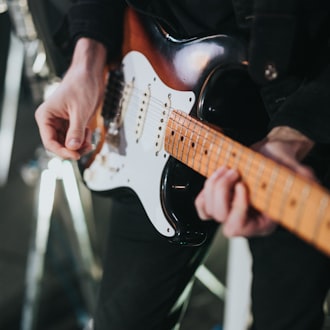
Gilmour joined Pink Floyd in 1968 under poignant circumstances, brought in to cover for his childhood friend Syd Barrett, the band's original leader, whose mental health was deteriorating, until Barrett left entirely. From there Gilmour helped steer the band to era-defining albums like The Dark Side of the Moon, Wish You Were Here, Animals, and The Wall. His playing on Comfortably Numb, Shine On You Crazy Diamond, Time, and Dogs is routinely voted among the greatest guitar work ever recorded, all built on his huge, singing tone and his gift for melody. He favored a black Fender Stratocaster, lovingly known as the Black Strat, that became as iconic as the music it made.
Here is the gem that shows what that guitar meant to the world. In 2019 Gilmour auctioned off his enormous personal collection of more than 120 guitars at Christie's, with the proceeds going to fight climate change. The sale raised over twenty million dollars, and the Black Strat alone, the instrument behind so many of his most famous solos, sold for nearly four million dollars, a record for a guitar at the time. He gave away the very tools of his legend to do some good with them, which fits everything about how he plays, generous, unhurried, and aimed at something bigger than showing off.
A second gem reveals his experimental ear. Gilmour was a sonic adventurer who coaxed unguitar-like sounds from his rig, the seagull cries and whale songs of Echoes, made by plugging a wah pedal in backwards, and the slide and lap-steel textures that drift through the Floyd's spaciest passages. Yet every experiment served the emotion of the song rather than mere novelty.
Gilmour eventually led Pink Floyd through their later years and steered their final albums, and he has continued making richly atmospheric solo records, often in collaboration with his wife, the novelist Polly Samson, who writes many of his lyrics. A Rock and Roll Hall of Fame inductee with Pink Floyd, he is, for countless guitarists, the proof that the most powerful thing you can do with a guitar is make it feel like a human voice, and that one perfectly placed, perfectly bent note can say more than a hundred fast ones. Few players have ever wrung so much pure feeling from so few notes.
Legendary Performance
Live at Pompeii
July 7-8, 2016 · Pompeii Amphitheatre, Pompeii, Italy
The Pompeii Amphitheatre was built around 90 BC. It was buried under volcanic ash when Mount Vesuvius erupted in AD 79 and lay entombed for nearly seventeen centuries before its excavation. For almost two thousand years, no one had performed inside it for a paying audience, gladiators had been its last entertainers, and they had not been there by choice. On July 7 and 8, 2016, David Gilmour changed all of that, bringing a two-night concert to the ancient stone oval for approximately 2,700 people per evening. The occasion carried a personal resonance of its own: forty-five years earlier, a then-unknown Pink Floyd had filmed a concert in the same amphitheatre, performing to an empty house for Adrian Maben's landmark film.
Gilmour played to the space as though it had been built for him. The acoustic properties of the ancient stone, the way it held sound without distorting it, returning it to the players in a form that made every note feel considered, seemed to free something in his playing that the scale of conventional stadium touring had always partly suppressed. His solos on "Comfortably Numb," performed in the shadow of the volcano that had created the venue, were among the most emotionally concentrated of his career: long melodic arcs that emerged from the surrounding silence rather than interrupted it, built with the patience of someone who understood that in this place, there was no need to rush. Every sustain lasted exactly as long as it needed to last.
The concerts were filmed and released in 2017, receiving an IMDB rating of 8.7, among the highest ever earned by a concert film. Critics who had followed Gilmour's career since the 1970s described the Pompeii shows as the fullest expression they had seen of what he was capable of as a solo artist: freed from the machinery and mythology of Pink Floyd, answerable only to the music and the extraordinary room. He was seventy years old. The volcano had not erupted in nearly two thousand years. The guitar had never sounded better.
▶ Watch on YouTubeGear
1969 Fender Stratocaster, "The Black Strat" (1969)
Known for: "Comfortably Numb", The Wall, 1979
No guitar has been more completely identified with the sound of a single musician than the Black Strat and David Gilmour. Acquired in 1970 for approximately £100, this 1969 Fender Stratocaster accompanied Gilmour through the recording of Meddle, The Dark Side of the Moon, Wish You Were Here, Animals, and The Wall. Its neck pickup, run through Gilmour's preferred signal chain and into Hiwatt amplifiers, produced the sustained, singing tone that defined Pink Floyd's sound across their most celebrated decade.
The guitar's most celebrated moment came on the second solo of "Comfortably Numb", played in a single take in 1979. The phrase is not technically complex by the standards of its era. What it is, instead, is emotionally irreducible: a melody that arrives fully formed and stays there, suspended above the track. Gilmour sold the Black Strat at auction in 2019 for $3.975 million, at the time, the highest price ever paid for a guitar at auction.
Hiwatt DR103 Custom 100, into WEM Super Starfinder Cabs
Known for: "Shine On You Crazy Diamond", Wish You Were Here, 1975
While most of Gilmour's contemporaries were pushing Marshall stacks, Gilmour built his signature tone around Hiwatt Custom 100 amplifiers. The Hiwatt stayed clean at volumes that would send a Marshall into distortion, which meant Gilmour could use pedals to add gain and colour while the amplifier itself remained a neutral, perfectly even platform for projection.
Paired with WEM Super Starfinder 200 cabinets loaded with Fane speakers, the Hiwatt rigs produced a sound of exceptional presence and definition. "Shine On You Crazy Diamond" demonstrates the combination at its most expansive: four slow notes stretched across what feels like a full minute before the band enters.
Electro-Harmonix Big Muff Pi
The Electro-Harmonix Big Muff Pi is technically a fuzz pedal, but in Gilmour's hands it became something closer to a sustain engine. Gilmour ran it into his Hiwatt amps with the tone control adjusted to preserve the midrange clarity the pedal tends to scoop out, arriving at a sound that was simultaneously heavy and articulate, compressed and expressive.
The Big Muff is most audible on "Dogs" from Animals. What the pedal provided was the ability to sustain single notes for extraordinary durations without the sound becoming vague. Each note remained identifiable in pitch, shaped by Gilmour's vibrato, responsive to his pick attack. The note didn't stop until Gilmour decided it should, and then it stopped cleanly.
Signature Technique
Sustained Vibrato & Melodic Space
David Gilmour's defining technique is restraint deployed as a weapon. He plays slowly, holds notes for long durations, and applies a wide, even vibrato that gives each sustained pitch the quality of a voice finding its breath. The vibrato itself, a gentle, deep undulation applied after a note has settled, is physically unhurried but emotionally expansive. Gilmour uses it to keep a note alive long after its initial attack has faded, turning single sustained tones into passages of feeling.
The famous solo in "Comfortably Numb" is built almost entirely on this principle. The first note of the second solo is bent, held, and vibrated for several seconds before the phrase moves anywhere. That single held note, heard in context with the wall of sound behind it, is one of the most emotionally powerful moments in rock history. Gilmour understood that space between notes carries as much meaning as the notes themselves, and his solos are as much about silence as about sound.